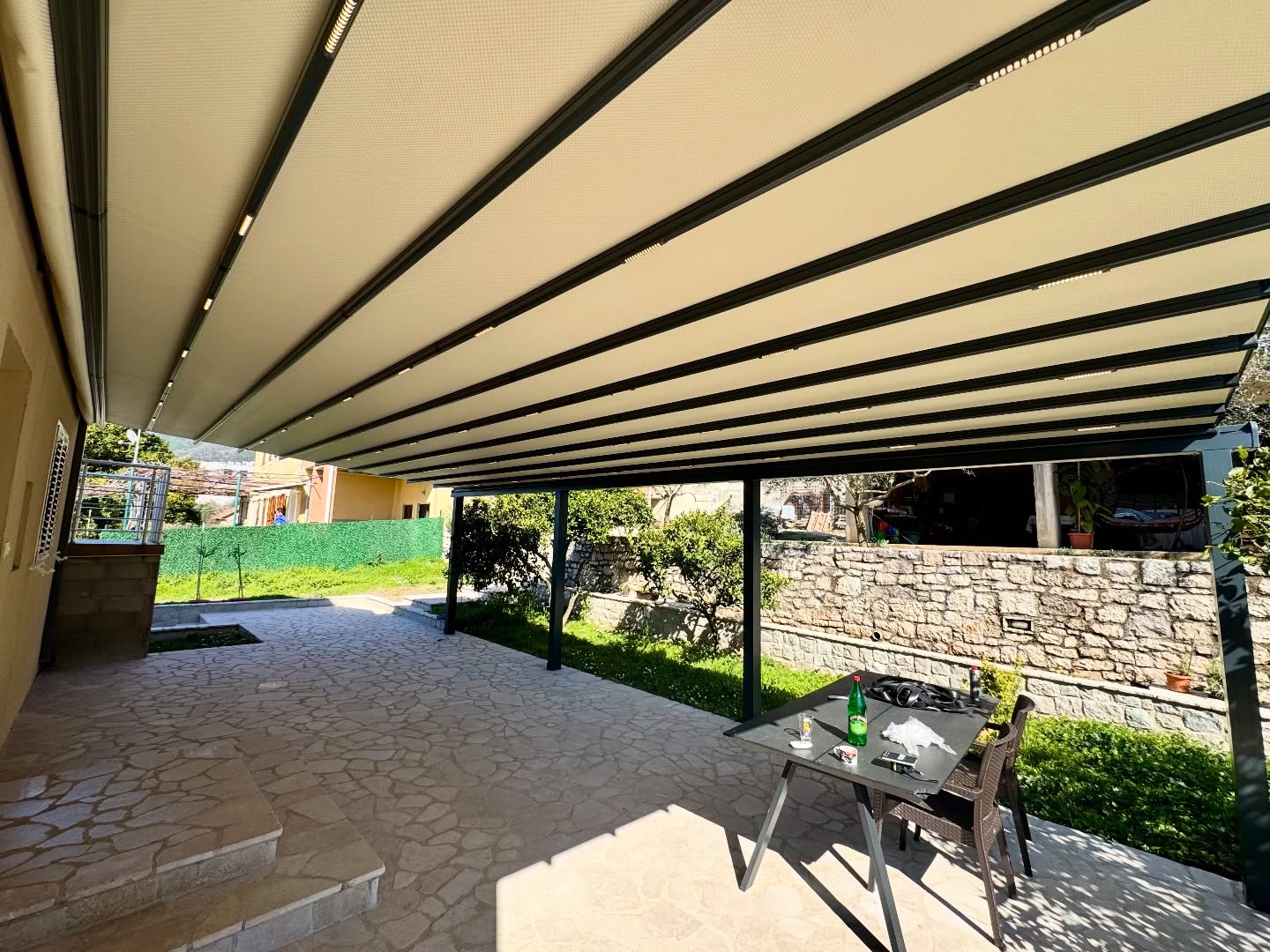
If you operate a restaurant, café, or food and beverage venue with outdoor seating, a bioclimatic pergola is the single highest-ROI investment you can make in your outdoor space. This guide covers everything a hospitality buyer needs to know — from technical specifications and cost breakdown to ROI analysis and installation timeline.
Why Restaurants Choose Bioclimatic Pergolas
The economics are straightforward. An uncovered outdoor terrace generates revenue for approximately 4–5 months per year in northern and central European climates — mid-spring through early autumn, weather permitting. A properly covered terrace with a bioclimatic pergola operates for 10–11 months per year, in rain, in wind, on cool evenings and at midday in summer heat.
For a restaurant with 30 outdoor covers averaging €35 per cover per sitting, two sittings per evening: that is €2,100 per evening in outdoor revenue. Extending the season by 5 months — approximately 150 days — adds €315,000 in potential outdoor revenue annually. Even at 40% capacity utilization, the figure exceeds €120,000 per year. A bioclimatic pergola for a 60m² terrace costs €8,000–€18,000 installed from a European supplier, or €4,000–€8,000 factory-direct from Turkey. Payback period: 2–6 weeks of operational use.
Restaurant Terrace ROI — Quick Calculation
What Makes a Bioclimatic Pergola Different from a Fixed Awning?
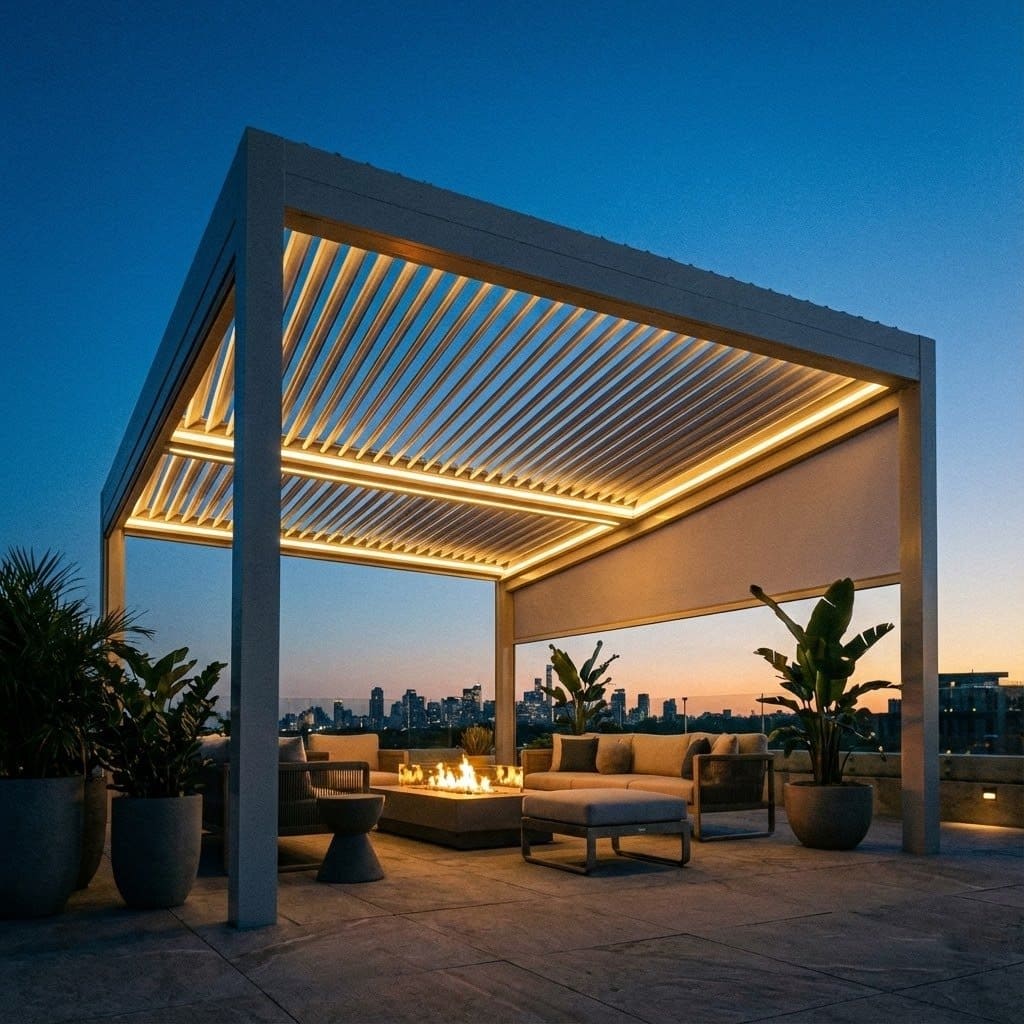
A fixed awning or standard pergola roof gives you one setting: open or closed. A bioclimatic pergola gives you a continuous spectrum of control. The aluminum louvers — each typically 250mm wide — rotate independently from 0° (fully closed, completely rain-proof) to 135° (maximum ventilation). At any angle in between, you control exactly how much sunlight enters, how much air circulates, and how much rain is blocked.
For restaurant operators, this means: midday summer service with louvers at 45° — partial shade, good airflow, no stuffiness. Evening service in autumn — louvers closed, infrared heaters on, guests comfortable at 12°C ambient outdoor temperature. Summer rain shower — louvers close automatically via rain sensor, service continues without interruption.
Technical Specifications for Restaurant Use
| Specification | Standard | Why It Matters for Restaurants |
|---|---|---|
| Profile material | 6063-T5 extruded aluminum | Corrosion-resistant, food-safe, cleanable |
| Rain sensor | Optional — strongly recommended | Auto-closes in rain — no staff intervention needed |
| Wind resistance | 80–100 km/h | Stays operational in coastal/urban wind conditions |
| Integrated LED | Optional — 2700K warm white | Eliminates need for separate lighting infrastructure |
| Infrared heating channel | Optional bracket system | Extends season into winter without gas heaters |
| Side zip screens | Optional — full enclosure | Creates fully enclosed outdoor room, year-round use |
Cost: European Brands vs. Turkish Factory-Direct
For a standard restaurant terrace of 40–80m², the cost of a bioclimatic pergola varies dramatically based on where you source it. European premium brands (Weinor, Markilux, Renson, Corradi) typically quote €12,000–€22,000 installed for a 60m² system. Turkish factory-direct supply — same aluminum specification, same motor brands — costs €4,500–€9,000 landed in Europe, plus local installation at €1,500–€3,000.
For multi-location restaurant chains or hotel groups equipping multiple terraces simultaneously, the factory-direct model saves €5,000–€12,000 per terrace — enough to fund an additional terrace or significantly improve the specification of each one.
Send us your terrace dimensions — width, depth, installation height. We provide a full export price within 48 hours, including shipping cost to your country.
Request Restaurant Quote →What to Ask Your Supplier Before Ordering
- What aluminum alloy grade are the profiles? (Answer should be 6063-T5)
- Which motor brand is included? (Somfy, NICE or Came — avoid unknown brands)
- Is a rain sensor included or optional? What is the sensor brand?
- What is the wind resistance rating — and at which blade angle?
- What are the structural post dimensions? Will they obstruct sightlines?
- Can you provide structural load calculations for planning permission?
- What RAL colors are available, and is there a surcharge for custom colors?
- What is the production lead time and shipping time to my location?
Related Products for Complete Terrace Enclosure
A bioclimatic pergola roof is the starting point. To create a fully enclosed, year-round dining terrace, combine with side enclosure solutions. The most popular combination for restaurants is a bioclimatic pergola overhead with zip screen curtains on the sides — the zip screens roll up completely when weather permits, maintaining the open-air character guests expect. For colder climates, glass terrace enclosure panels create a fully insulated dining room that retains full transparency.