A bioclimatic pergola system from TentPergola ships as a flat-packed, numbered component set with full assembly drawings. A standard 4×5m system can be installed by two people in one working day. This guide walks through every stage of the installation process — from foundation preparation to motor commissioning.
Before You Start — Tools Required
Step 1 — Foundation and Post Positions
Mark the four (or more, for multi-span) post positions on the ground using your assembly drawing as reference. Post spacing must match the drawing exactly — typically the outer dimension of the system. Check diagonal measurements to ensure the layout is perfectly square: both diagonals must be equal.
For freestanding installations on a concrete slab, drill anchor bolt positions using the base plate as a template. Use M12 chemical anchors (Hilti HIT-RE 500 or equivalent) with minimum 120mm embedment depth in a C25 slab. For installations on paving or tiles, consult your structural engineer for the correct anchor specification. Wall-mounted systems use the wall plate supplied in the kit.
Step 2 — Post Installation
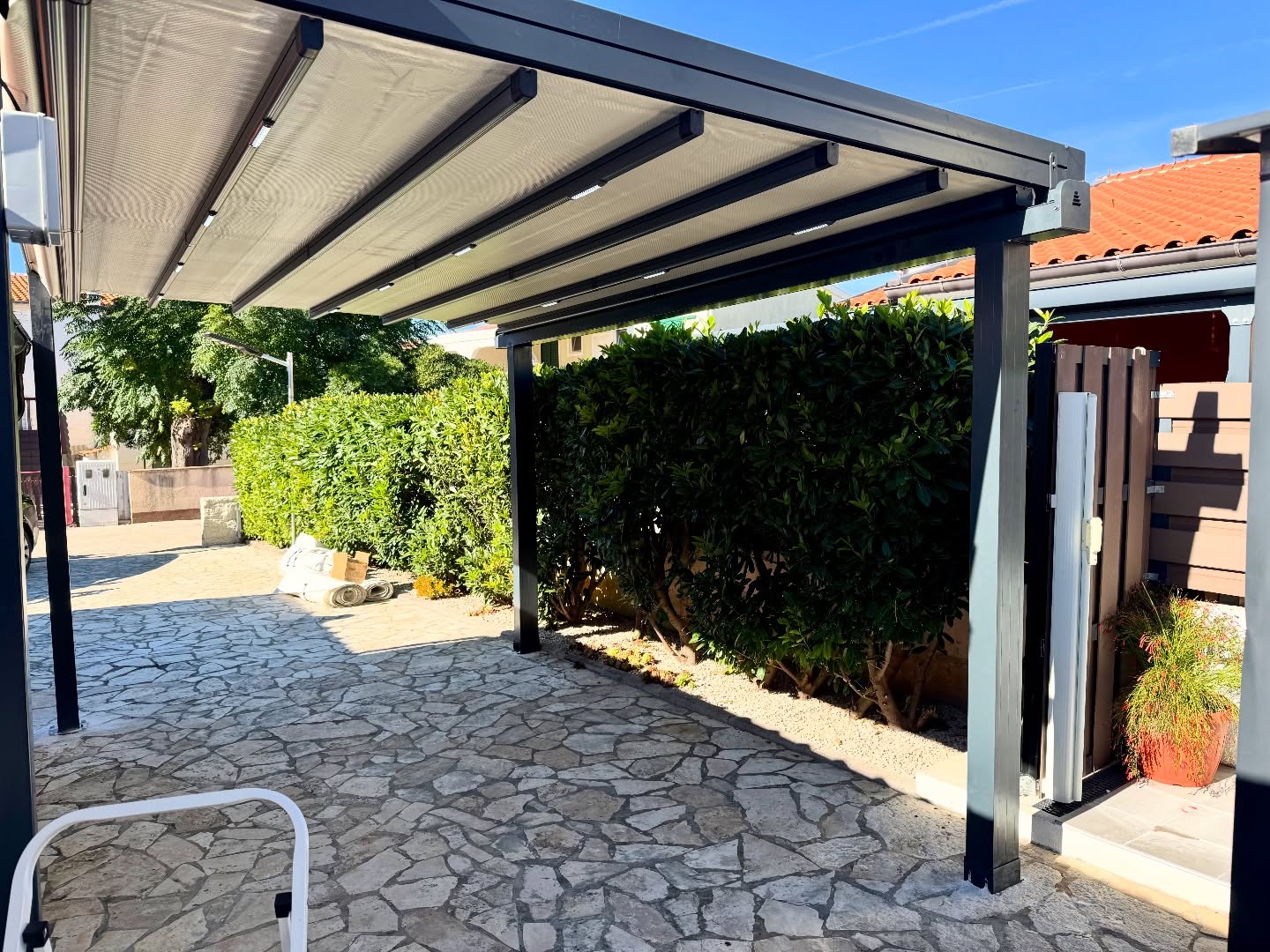
Insert the base plate anchor bolts and allow chemical anchors to cure (minimum 2 hours at 20°C, longer in cold conditions — follow manufacturer data sheet). Once cured, attach the base plates. Stand each post vertically and bolt to the base plate — do not fully tighten at this stage. Use a spirit level to plumb each post in both planes. Once all posts are plumb and correctly positioned, fully tighten all base plate bolts to the torque specified in the assembly drawing.
The drainage downpipe runs inside each post. Before installing the beam, thread the downpipe through the post from the top. The downpipe connects to the roof gutter beam at the top and exits at the base plate level, where it connects to your drainage system.
Step 3 — Beam Assembly
The main beams (rafter beams running front-to-back) connect the posts and carry the blade load. Each beam is a single aluminum extrusion with an integrated gutter channel on the inner face. Lift the beam onto the post capitals and secure with the connection bolts supplied. The beam must be level side-to-side; a 2–5mm fall toward the drainage post is correct and intentional — this ensures rainwater drains toward the downpipe.
Step 4 — Blade Installation
Each aluminum blade pivots on two end brackets fixed to the inner face of the beams. Install end brackets at the spacing shown on your drawing — typically 250mm intervals (blade width). Insert each blade by angling it diagonally and hooking both pivot pins simultaneously into the brackets. The pivot pins should snap into the bracket sockets with firm hand pressure. Do not use tools to force the pins — if resistance is felt, check alignment.
Once all blades are installed, connect the blade linkage rod — this is the mechanical element that synchronizes all blades to move together. The linkage rod clips to a lug on each blade end. Verify that all blades move together smoothly when the linkage rod is pushed manually before connecting the motor.
Step 5 — Motor Connection and Commissioning
The tubular motor is pre-installed in the motor housing at the factory. On site, connect the motor cable to the junction box in the post according to the wiring diagram supplied. The motor cable is color-coded: brown (live), blue (neutral), green/yellow (earth), grey (direction 1), black (direction 2). Have a licensed electrician make the final mains connection.
Commission the motor by running it to the fully closed position and setting the end stop. Then run to the fully open position and set the second end stop. Refer to the motor brand manual for the specific end-stop setting procedure — Somfy, NICE and Came each have slightly different commissioning sequences. Video guides for each motor brand are included in your export package and available on request via WhatsApp.
Step 6 — Sensor and Smart Control (Optional)
If your system includes a rain sensor, wind sensor or sun sensor, mount the sensor at the highest accessible point of the structure per the sensor manufacturer's instructions. Connect to the motor control unit via the sensor cable. Program the threshold values for automatic closure — typically 15–20 km/h for wind sensors, any rain contact for rain sensors.
For smart home integration (Somfy TaHoma, NICE Home, or third-party KNX/Zigbee), follow the app commissioning process. This typically involves pairing the motor receiver with the app via a short radio command sequence. Full instructions are included with each motor unit.
All TentPergola export packages include AutoCAD assembly drawings, numbered component lists, installation manual and WhatsApp video support. Contact our team at any stage of installation.
Contact Export Team →